Honoring Revolutionary War Veterans, Free and Enslaved
As part of America’s 250th commemorations, the America’s 250th Norwich CT Committee is helping bring long-overlooked stories of service, sacrifice, and resilience to public view. Through a new mural, commemorative plaque, lectures, and public programs, this initiative honors Black and Indigenous Revolutionary War veterans connected to Norwich and southeastern Connecticut, including both free and enslaved men who served during the struggle for independence.
The project also recognizes Primus, an enslaved man in Norwich whose story was memorialized in Lydia Sigourney’s 1824 book. By sharing Primus’s story alongside the names and experiences of Black and Indigenous soldiers, this commemoration invites the public to reflect on the fuller, more complex history of the American Revolution and the people whose contributions have too often gone unrecognized.
A Fuller Story of the American Revolution
The American Revolution is often remembered through the names of generals, statesmen, and signers. Yet the fight for independence also included the labor, service, and sacrifices of many people whose stories were not equally preserved in the historical record.
Black and Indigenous men served in the Revolutionary War in many roles, including as soldiers, sailors, laborers, and support personnel. Some served as free men, while others were enslaved. Their participation raises important questions about freedom, citizenship, service, and the meaning of liberty in a nation still struggling with slavery, dispossession, and inequality.
In Norwich and the surrounding region, these histories are deeply connected to local families, burial grounds, churches, farms, waterways, and communities. This commemoration seeks to bring those stories into public view and create a lasting place of recognition.
The Primus Project: Mural and Commemorative Plaque
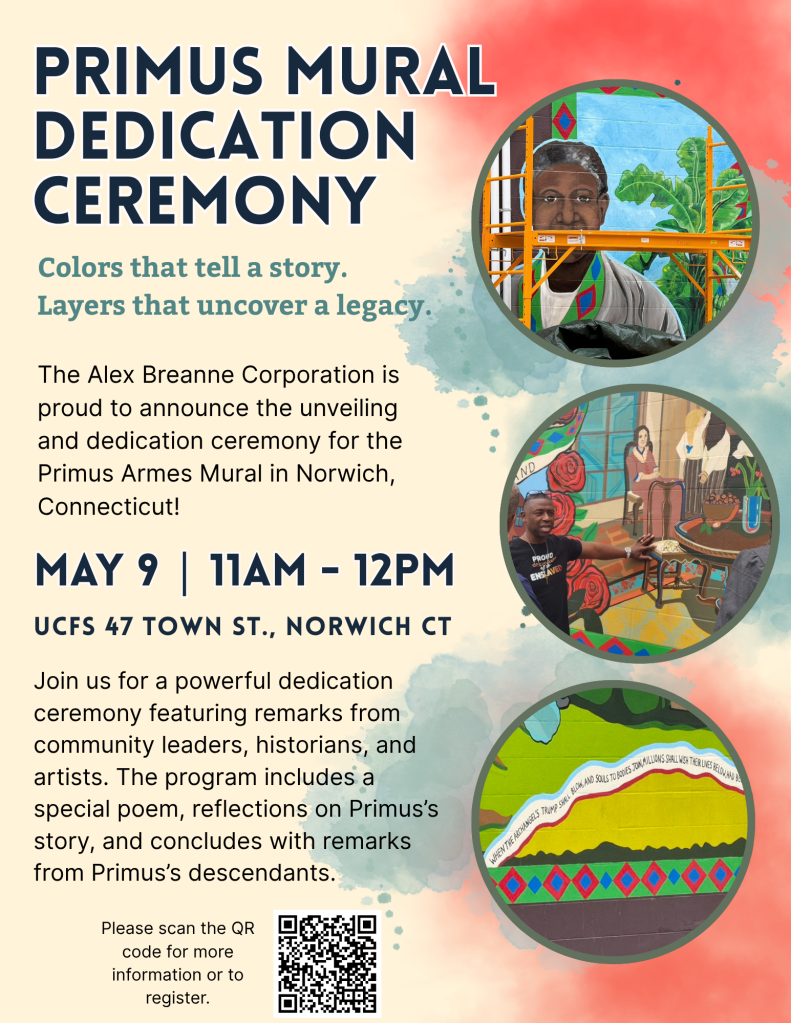
At the center of this initiative is the story of Primus, an enslaved man from Norwich whose life was recorded in Lydia Sigourney’s 1824 book, A Sketch of Connecticut, Forty Years Since. Preserved through a nineteenth-century literary source, Primus’s life points to a much broader history of enslaved and marginalized people in Norwich whose experiences remain underrepresented in public memory.
The Primus Armes Mural will be unveiled at the Edward & Mary Lord Family Health Center at 47 Town Street in Norwich, near the Norwichtown Cemetery. Presented by the Alex Breanne Corporation in collaboration with UCFS Healthcare, the Norwich Historical Society, Public Art for Racial Justice Education, and the NAACP Norwich Branch, the mural honors Primus Armes and celebrates the legacy of his descendants.
Primus’s story is one of survival, family, and resilience. Captured in The Gambia in the early 18th century and forced onto a slave ship, Primus arrived in America alone after his father died during the Middle Passage. He was enslaved in Norwich, where he later built a family with his wife, Venus. His son, Job Lathrop, served in the Revolutionary War while still enslaved, crossing the Delaware with General George Washington before fighting in the Battle of Trenton. Generations later, two of Primus’s second great-grandsons served in the Civil War as members of the 29th Connecticut Colored Regiment.
The mural depicts Primus’s journey from The Gambia to Norwich and brings public attention to long-overlooked stories of service, ancestry, and resilience. An accompanying commemorative plaque near the Norwichtown Colonial Burying Ground will provide historical context and recognize Black and Indigenous Revolutionary War veterans connected to Norwich, including both free and enslaved men.
Together, the mural and plaque create a lasting place of remembrance at one of Norwich’s most historic sites. The installation invites residents and visitors to pause, learn, and reflect on the fuller history of liberty, sacrifice, and belonging in Revolutionary-era Norwich.
Lectures and Public Programs
In addition to the mural and plaque, the commemoration includes lectures, events, and educational programs dedicated to underrepresented voices in Revolutionary-era history.
These programs will explore topics such as Black and Indigenous military service, slavery in colonial and Revolutionary-era Connecticut, local family histories, genealogy, public memory, and the ways communities choose to honor the past.
By pairing public art with public education, the project creates opportunities for residents, students, historians, descendants, and visitors to learn together and reflect on the enduring importance of these stories.
A Lasting Place of Remembrance
The Black & Indigenous Soldier Commemorations will create a lasting tribute at the Norwichtown Cemetery, connecting public art, historical interpretation, and community education.
Through the mural, plaque, and related programming, Norwich will honor the lives and service of Black and Indigenous Revolutionary War veterans and recognize Primus as part of a larger effort to bring long-overlooked stories to light.
This project reflects a commitment to remembrance, education, and a fuller understanding of America’s founding history.
America’s 250th Norwich CT Committee is proud to support this important commemoration as part of Norwich’s observance of the 250th anniversary of the American Revolution and the Declaration of Independence.

